

Demographics
The demographics of the town of Rota have changed considerably both in the past and in the present century, as numerous events have led to an increase in population and per capita income. In the following sections, we detail each of the relevant aspects that have influenced this increase.
Population Trends
The population of the town of Rota is 29,109, of which 14,505 are men and 14,604 are women, according to data from the National Institute of Statistics (up to and including December 2019). This balance, with an equal number of people of both sexes, has been maintained continuously since the 1980s.
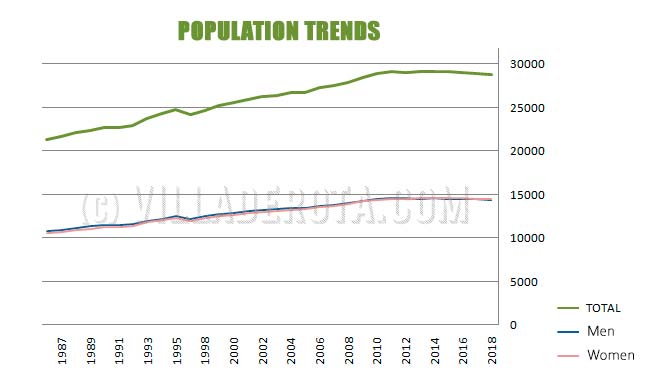
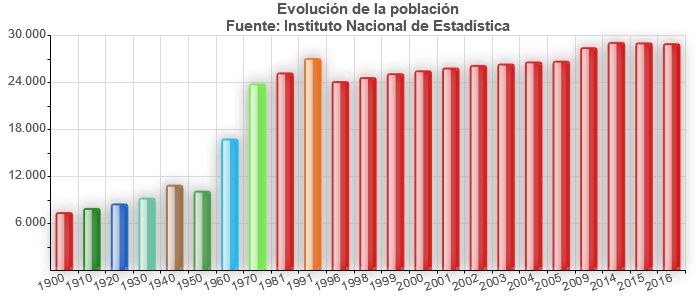
In 1900, our town had 7,471 inhabitants, a number that increased after the Spanish Civil War (1936-1939) to 10,958 in 1940, due to its geographical location away from the conflict.
With the arrival of the Rota Naval Base (1953), the local population grew dramatically, as the local economy was very attractive to anyone "outsider" (a term used to refer to anyone not from Rota): 10,193 people in 1950, 16,856 in 1960, and 23,885 in 1970. In the last two decades of the 20th century, our town maintained a population of around 23,000, with notable peaks in birth rates in the 1980s and an increase in the foreign population in the late 1990s. With the introduction of the euro (January 1, 2002), a continuous increase in population was experienced, thanks to the excellent economic conditions at the time in certain sectors such as construction. However, this growth began to slow with the long global crisis of 2008. The second decade of the 21st century was marked by a period of significant job insecurity, during which the number of births decreased, emigration from Rota increased, and the mortality rate began to rise (see details below). In March 2019, the local unemployment rate was 25.28%, and the precarious wages offered by temporary local employment are insufficient for many families, leading to a societal model linked to seasonal tourist towns. Another important fact is female unemployment, as it tends to be high (approximately 24-27% annually), compared to male unemployment (approximately 16-19% annually).
The increase in the population of our Villa from 2004 to 2014 was 9.32%. Noteworthy is the number of foreigners registered until 2014, which was 1,070, 3.66% of the total population, most of North American, German, Dutch and Belgian nationality. Most parts of the US population are retired military and family members. The rest of the nationalities indicated to include a previously tourist sector that has been recurring for consecutive years and trips, thanks mainly to climate and proximity to the sea, they have chosen to reside continuously or in summer in our city during their retirements.
Finally, we must indicate that our Villa is divided into 3 nuclei: Rota "Sur", Rota "Norte" (Costa Ballena with 401 inhabitants registered) and Rota "Naval" (128 inhabitants registered with residence in the military compound).
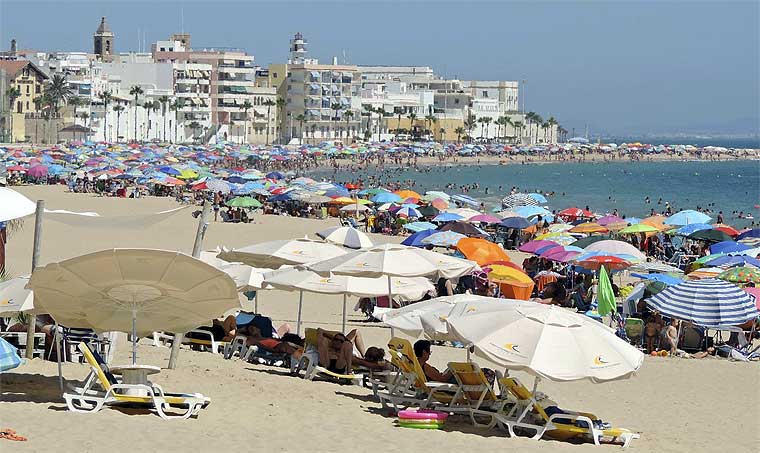
Apart from these demographic data, it should be noted that the total population of the Villa triples during the summer months exceeding 100,000 inhabitants. Likewise, the American population residing inside and outside the military compound of the Naval Base is not counted in the total population and is estimated at about 6000 inhabitants in the year 2016.
{fastsocialshare}